From zero to playable: the 48-hour game jam narrative workflow

How to ship a complete narrative game in one weekend, without burning out halfway through.
The Global Game Jam 2026 countdown has started. Theme drops in a few days. You've got ideas. You've got energy.
Here's what you don't have: 48 hours to waste figuring out your process while the clock ticks.
After running a 72-hour narrative jam with 120 participants, we noticed a pattern among teams that actually finished. It wasn't about having the biggest ideas or the most experience, it was about having a clear workflow before the timer started.
The best jam games aren't the most ambitious. They're the most complete.
Here's the 5-phase workflow that gets you from theme announcement to playable story, without the panic.
Phase 1: Get clear before you get creative
The theme drops. Your team huddles. Ideas fly. Someone shouts "time-traveling detective!" Another yells "but with cats!"
Stop.
This is where most jams derail, not because ideas are bad, but because enthusiasm skips a critical question: Can we actually build this in 48 hours?
The 10-minute rule
If you can't explain your core concept, start, middle, end, in under 10 minutes, it's too complex. Simplify or pick something else.
Three moments, not three acts
Forget elaborate story structure. Nail three emotional beats: the hook, the choice, the payoff. Everything else is decoration.
Sketch before you write
Open Arcweave and map your flow visually:
Start → First Choice → Consequence A → Consequence B → Ending
Why? When you see your entire story on one screen, scope problems reveal themselves in minutes. "Wait, this branch needs 12 scenes? Cut it."
Teams working in docs and spreadsheets discovered those problems too late to fix.
Action Item: Decide your THREE core moments and sketch the connections in Arcweave before writing dialogue.
Phase 2: Structure first, details later
You've got your concept. Now comes the hardest part: resisting the urge to write.
The teams that finished didn't start with beautiful prose. They started with empty placeholders connected by arrows.
Why structure-first works
Linear writing feels productive, until you hit a plot hole and realize you need to restructure everything. Visual structure shows problems immediately:
- "This branch has no way back to the main path"
- "The player can't actually reach this ending"
- "These two branches need to reconnect but the logic breaks"
Fix these early = minutes.
Fix them during final polish = rewriting half your story.
The critical path rule
Your story needs ONE complete path from start to finish. Everything else, branches, flavor text, easter eggs, is optional.
During our jam, teams with gorgeously complex flowcharts (10+ branches, nested choices) almost never finished. The teams that shipped had ruthlessly simple structures: one critical path + two meaningful branches. That's it.
Arcweave's visual flowchart made complexity visible, and therefore cuttable.
⚠️ Common pitfall: "We'll figure out how branches reconnect later." (Spoiler: you won't. And you'll be kicking yourself.)
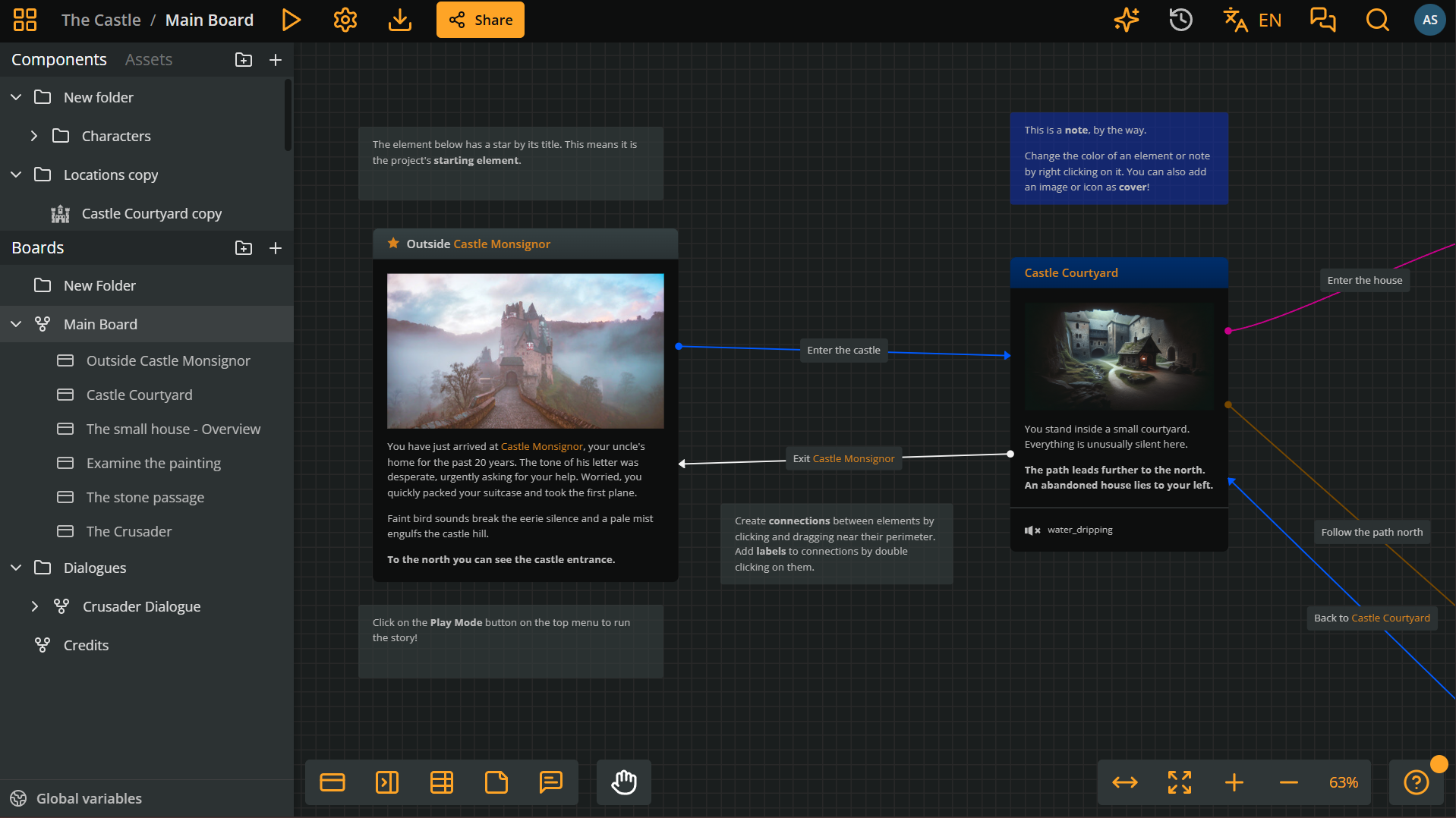
Action Item: Lock your structure before moving to content. One critical path + max 2 branches. Screenshot it, it's your north star.
Phase 3: Content sprint (Volume over Perfection)
Structure's locked. Now you write. Fast.
Placeholder power
[BOSS CONFRONTATION] is better than a blank space. [Player makes difficult choice about loyalty] beats cursor-staring paralysis.
The fastest teams filled their entire structure with placeholders first, then did a second pass adding actual content. Seeing "complete but rough" is psychologically different from "half-done and pretty."
Test while you build
If you can't test your story until late development (after exporting and building), you're designing blind.
Teams using Arcweave's Play Mode tested their branching continuously while writing. One team caught a major logic error where a choice promised "you'll remember this" but the variable wasn't tracking.
The top-down polish rule
Players experience your story sequentially. They need a strong opening more than a perfect ending most won't reach.
💡 Priority balance: Spend most polish time on the first third of your story. That's your hook.
Action Item: Rough-draft your entire critical path first. Polish opening and first major choice. That's what keeps players engaged.
Phase 4: Testing reality & tough triage
You've got content and structure. Now the hard question: does it actually work?
Fresh eyes protocol
Get someone to playtest. Early. Not "when I finish." Before final polish.
Your mental map ≠ player experience. You know where every branch goes. They don't.
One team discovered testers consistently chose the "wrong" option because wording was confusing. One word change fixed it. If they'd waited until the last minute? No time to fix.
Arcweave's public sharing removed testing friction, teams sent a Play Mode link, testers clicked and played immediately. No downloads, no installs. Result? More testing, better feedback, cleaner games.
The 3-fix rule
You can't fix everything. Identify the 3 biggest problems. Fix those. Ship the rest.
Priority:
- Blocking bugs (can't progress)
- Confusing choices (players don't understand options)
- Immersion breaks (typos in opening, inconsistent names)
Everything else? Ships as-is.
Integration reality check
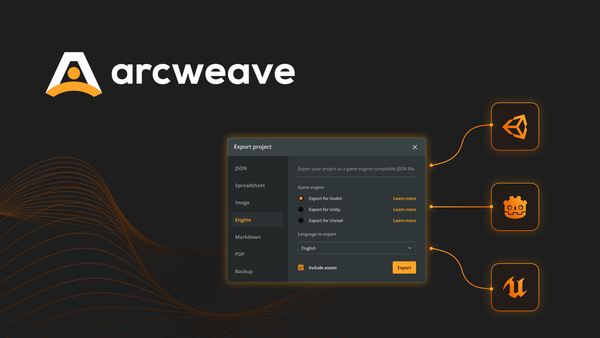
If you're exporting to Unity, Godot, or Unreal: test integration early, not at the last minute.
Multiple teams discovered export format errors late in development. Catastrophic.
Arcweave's engine-ready JSON exports meant teams could test Unity/Godot/Unreal integration throughout development. One team ran export tests regularly. Zero integration surprises.
⚠️ Critical: "The story works in my tool" ≠ "the export works." Test the full pipeline while you have time.
Action Item: Get a full playthrough before final polish. Fix top 3 issues only. Test engine integration if applicable. Lock content, no more structural changes.
Phase 5: Ship & breathe
You made it. You're exhausted. Your story isn't perfect.
Ship it anyway.
Good enough ships
A complete 15-minute story with rough edges beats an unfinished masterpiece. Every. Single. Time.
Your final job isn't making it better, it's making it shippable.
Final checklist
- ✅ Players can start and finish?
- ✅ All choices work?
- ✅ At least one complete path with no dead ends?
- ✅ Opening scenes are spell-checked?
Four yeses? You're done. Submit.
Embed your game directly
If you're submitting to itch.io or hosting on your own site, use Arcweave's Play Mode embed feature. Your story becomes instantly playable, no downloads, no installs, no "I'll play it later" (translation: never).
During our 72-hour jam, all 120 entries were playable directly in-browser. Result? Significantly higher play rates from judges and players. One-click-to-play removes the biggest barrier to engagement.
Custom styling for polish
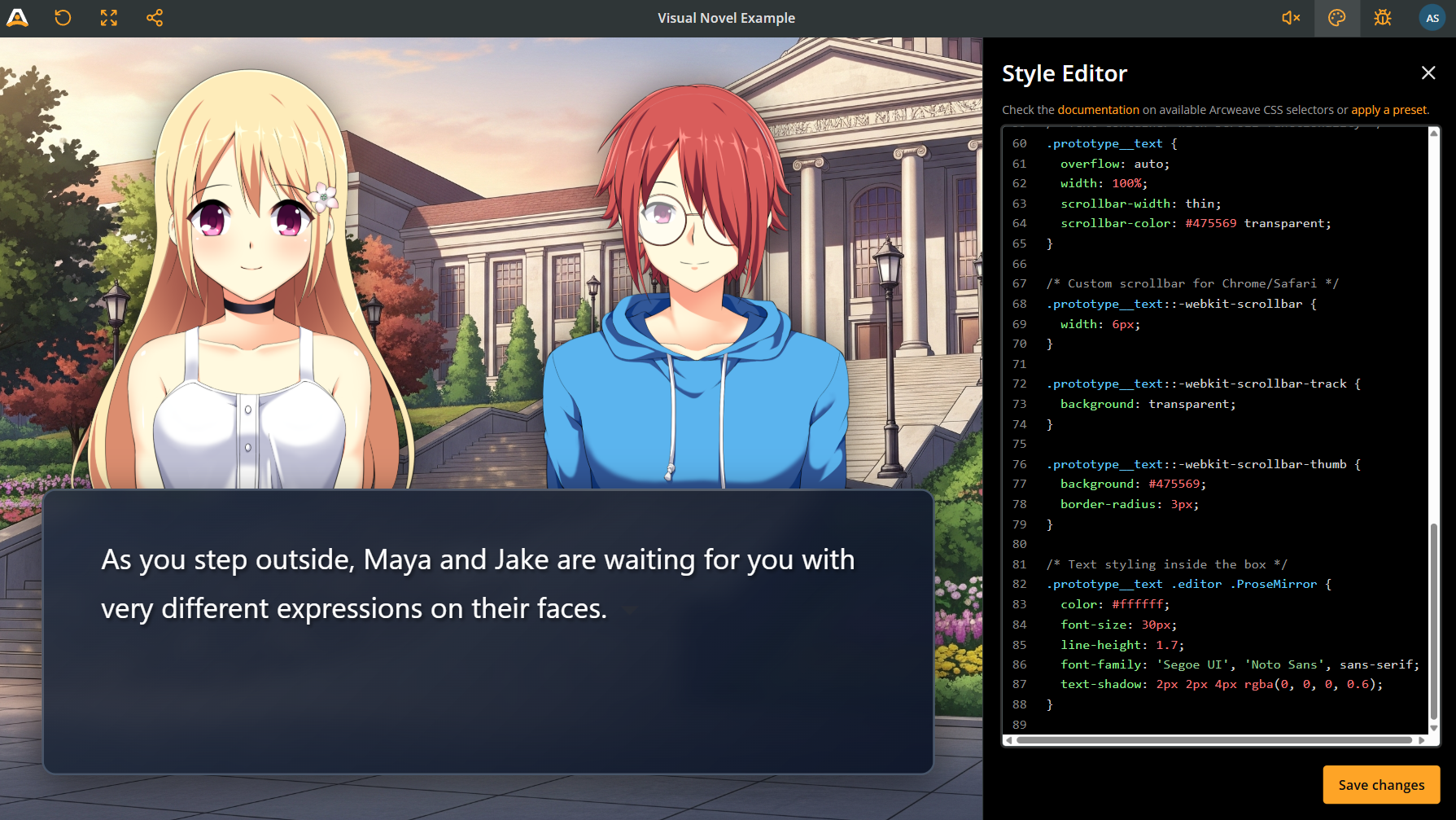
Don't settle for default UI. Use Arcweave's Style Editor to customize your Play Mode with CSS:
- Match your game's color scheme
- Adjust fonts for readability
- Style buttons and UI elements
- Create a polished, branded experience
The difference between "this looks like a prototype" and "this looks professional" is often just 20 minutes of CSS tweaking. Teams that customized their Play Mode styling consistently got higher presentation scores.
Resist last-minute features
Several teams had working games during the final stretch. Then they added "just one more branch" at the last minute. And broke everything.
Teams that locked content early and spent final time on presentation, screenshots, page polish, CSS styling, won awards.
💡 Pro Tip: Submit with time to spare. Use your final buffer for visual polish and celebration, not code changes.
Action item:
- Lock content 2 hours before deadline
- Embed your Play Mode in itch.io with custom CSS
- Add screenshots and description
- Submit early. Stop coding. Start celebrating.
Ready to prep for Global Game Jam 2026?
Watch: Arcweave video Crash Course
Everything you need to hit the ground running: visual structuring, instant testing, and engine-ready exports.
The teams that finish are the teams that prepared.
Don't wait until the theme announcement to figure out your tools and process. Lock them down now.
See you at Global Game Jam 2026. Let's ship something complete.